When Did Ray Charles Olay in Georgia Again
As a performer and recording artist in the tardily 1950s and early 1960s, Ray Charles pioneered a new mode of music that became known as "soul," a blend of gospel music, dejection, and jazz that brought him worldwide fame. Over the adjacent four decades his unique voice, passionate style of playing the piano, and tireless showmanship made him a legendary effigy in the world of entertainment.
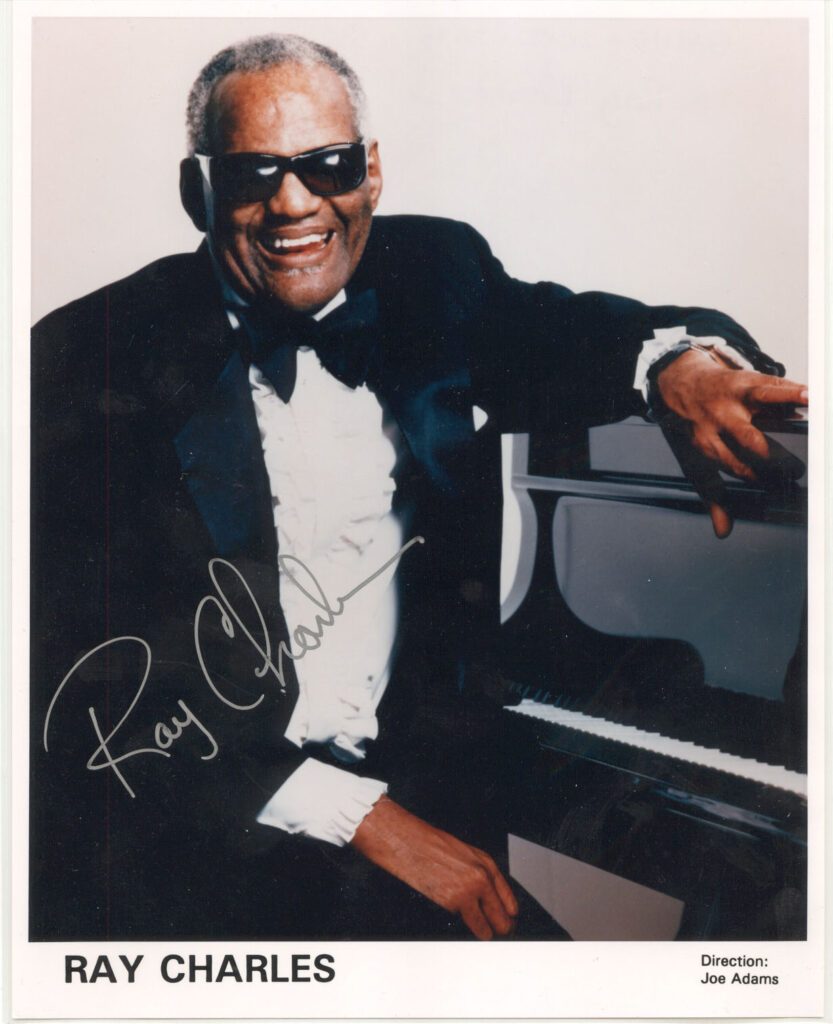
In the popular imagination Ray Charles volition probably ever be linked with his rendition of "Georgia on My Listen," his number-i pop hit of 1960. Over the next forty years, this "old sweet song" remained his signature slice, becoming Georgia'due south official country song in 1979.
Early Years
Ray Charles Robinson was born in Albany on September 23, 1930, the aforementioned yr that Hoagy Carmichael equanimous "Georgia on My Heed." A few months after his birth his mother, Aretha Williams, moved with RC (as everybody called the young Charles) to Greenville, a small town in north Florida.
At the age of v Charles slowly began to lose his sight, most probable every bit a effect of congenital juvenile glaucoma. In the same year his younger brother drowned. Despite these setbacks and dire poverty, his mother pushed Charles toward greater independence. After he was alleged legally bullheaded at the historic period of vii, she enrolled him in the Florida School for the Deaf and Blind in St. Augustine, where he remained for nine years, until her death in 1945.
Equally Charles describes in his 1978 memoirs, his early years were filled with music. Although no one in his family unit was a musician (his by and large absent male parent, Bailey Robinson, was a railroad employee), he found music in every direction: the raw, emotional sounds of gospel music in the church building, the jukebox at the full general shop that blasted out the blues, the boogie-woogie that the store possessor would play on pianoforte with the attentive young boy at his side. Charles likewise listened to big band music on the radio, along with hillbilly tunes from the Grand Ole Opry. At the school for the blind, Charles learned to read music and play Frederic Chopin, Ludwig van Beethoven, and Johann Strauss. Over fourth dimension he also discovered jazz music and a deep appreciation of jazz pianist Art Tatum.
Professional Years
In 1945 the 15-year-old Charles left school to make his living every bit a professional musician. His early travels took him to nearby Jacksonville and Orlando, Florida, where his reputation grew as a versatile piano player, saxophone actor, and arranger who could handle blues, jazz, boogie-woogie, swing, or hillbilly. He imitated the shine vocals of popular singers Charles Brown and Nat King Cole, and wouldn't develop his own singing style for at least another decade.
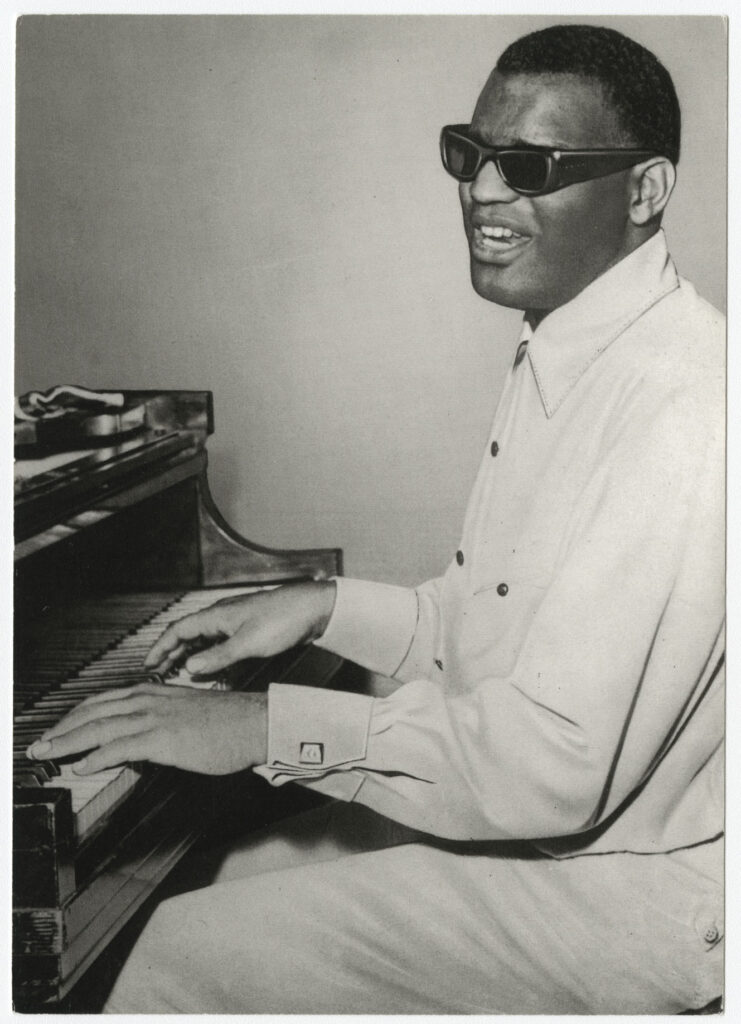
After his move to Seattle, Washington, in 1948 to pursue better career opportunities on the Due west Coast, Charles'due south bear witness-business persona began to emerge. He dropped his terminal name to avert possible confusion with the well-known boxer Sugar Ray Robinson. He also began wearing the dark glasses that would go his trademark. More important, he recorded his first vocal, which he followed the adjacent yr with his first national hitting on the Black charts ("Baby, Permit Me Agree Your Manus"). At the time Black culture was isolated and largely ignored past white mainstream culture, which accustomed merely a few Black musicians, including Chocolate-brown and Cole, every bit well as Fats Waller, Cab Calloway, and Louis Armstrong.
In 1950 Charles moved to Los Angeles, California, which later became his permanent domicile and the location of his individual recording studio, to seek his own popular success and financial independence. For the side by side few years he toured on the road, playing behind other musicians, ofttimes indelible long trips through the segregated Due south.
Soul Years
Once Charles began traveling, performing, and recording with his own band, the voice that would get his trademark took shape. His 1954 rhythm-and-dejection hit for Atlantic Records, "I Got a Adult female," was an electrifying synthesis of gospel music, blues, jazz, and boogie-woogie that became the blueprint for time to come hit songs. Information technology likewise brought howls of protestation from those who claimed his music was sacrilegious.
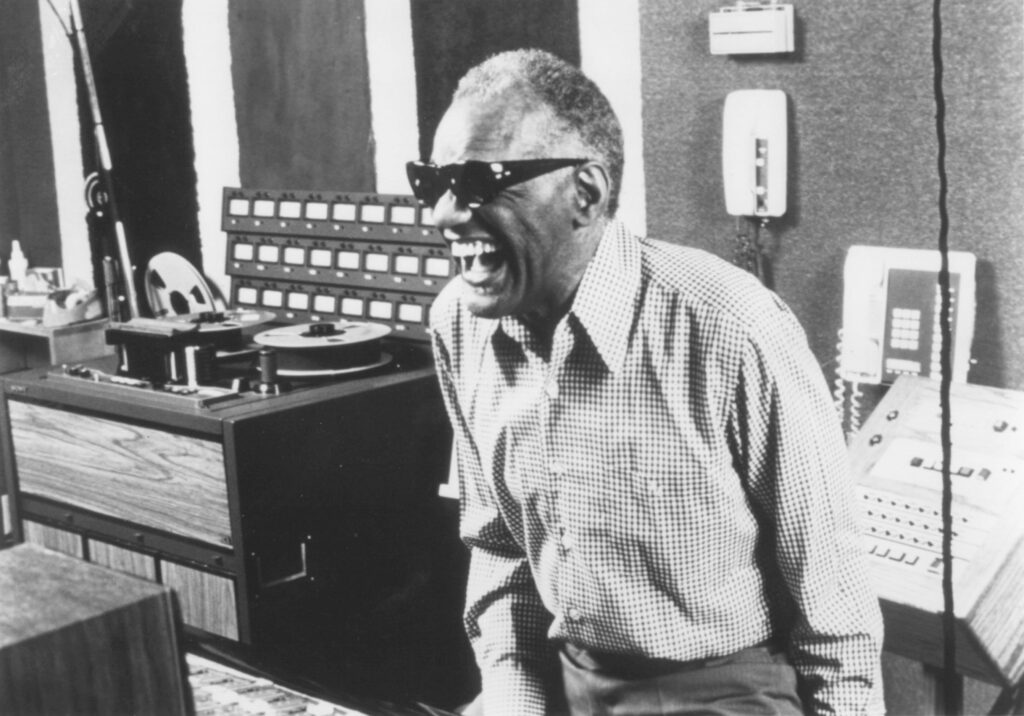
Charles insisted that he was only doing what came naturally—playing the music that came straight from his soul. Past doing and so, he appealed to a youthful audience of Blacks and whites akin who supported a new generation of energetic immature Black musicians that included Charles, Chuck Berry, and Little Richard.
Toward the terminate of 1955 Charles began experimenting with female backup singers, taking his cue from girls' gospel groups. Once he discovered the combination of feminine harmony with his strong, masculine vocals, he made the Raeletts a permanent improver to the ring in 1957. By that fourth dimension all the elements that would ascertain Charles's unique manner were in place: the gruff vocals that could express whatsoever caste of loneliness or exuberance, the expressive piano playing, the professional fill-in musicians who could follow his lead wherever he wanted to go, and the backup singers.
Over the next few years Charles recorded three number-one pop hits. "Georgia on My Mind" (1960) was followed by "Striking the Road Jack" (1961) and "I Can't Stop Loving You" (1962). The final song was included on a country and western anthology that surprised many critics and fans, merely he insisted that information technology was a natural expression of his musical heritage.
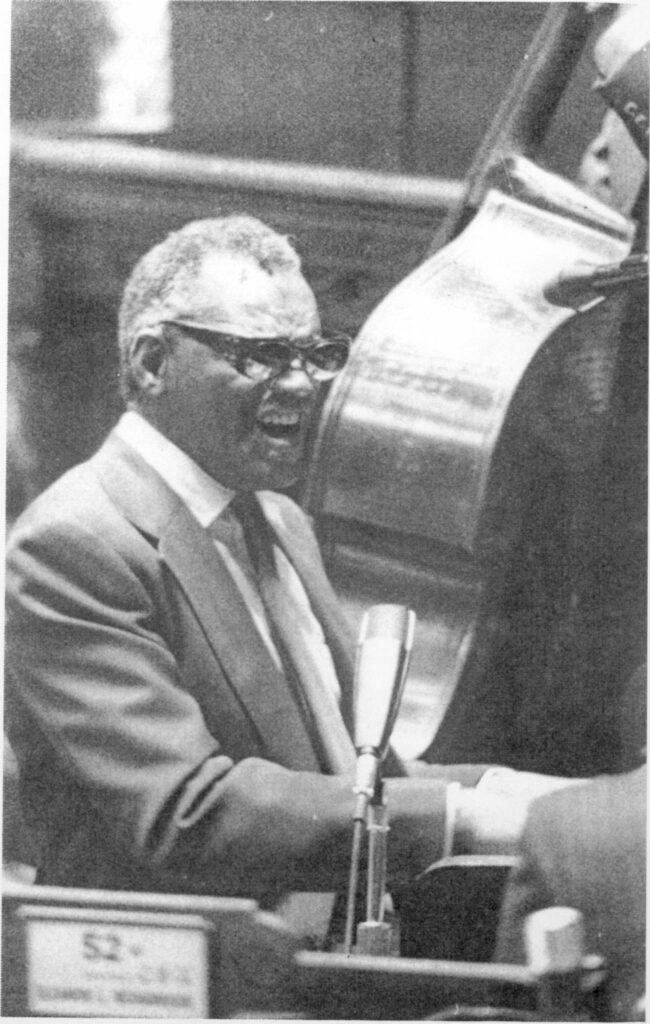
Charles'southward performing and touring did accept a toll on his personal and family life, however. His second marriage, to Della Howard, produced three children, just two paternity suits in the early 1960s revealed that he had fathered several more children out of spousal relationship. In 1964 he was arrested for possession of heroin and later admitted that he had been addicted since the late 1940s. Afterward a period of rehabilitation at a California sanitarium, Charles kicked his drug habit and received a 5-yr suspended judgement.
Legacy
Charles's music and reputation endured into the twenty-showtime century. His vibrant personality reached a new generation of fans in the 1980 picture show The Blues Brothers and in a 1990 Diet Pepsi commercial. He was the first performer inducted into the Georgia Music Hall of Fame (1979), and he is besides honored in the Blues Foundation's Blues Hall of Fame (1982 )and the Rock and Roll Hall of Fame (1986). He was awarded the National Medal of Arts in 1993. Charles died on June 10, 2004, of acute liver affliction at his domicile in Beverly Hills, California.
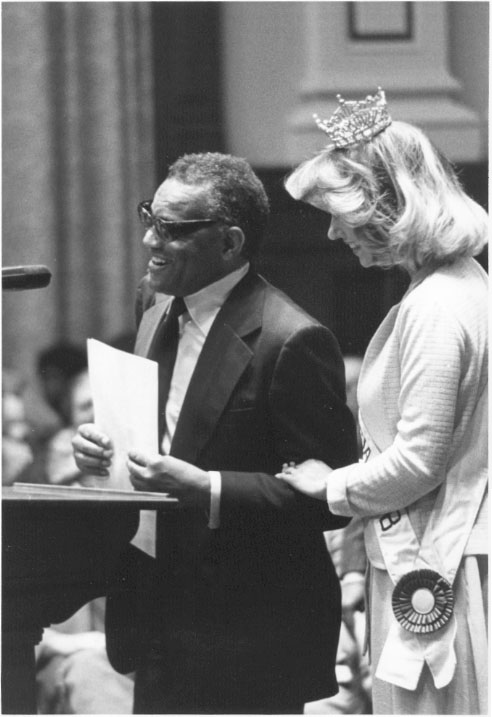
In the months following his decease, the legacy of Ray Charles continued to grow. A concluding album, Genius Loves Company, was released in September 2004 and consists of duets with twelve prominent singers. Charles's duet with Norah Jones, "Hither We Become Over again," won the Grammy Award for Record of the Year, while Genius Loves Company won the Grammy for Album of the Yr. The movement picture show Ray, which opened in October 2004, chronicles his childhood and career through the 1960s. Directed past Taylor Hackford, the moving-picture show features Jamie Foxx as Ray Charles in a widely acclaimed performance that garnered the actor both Gold World and Academy awards.
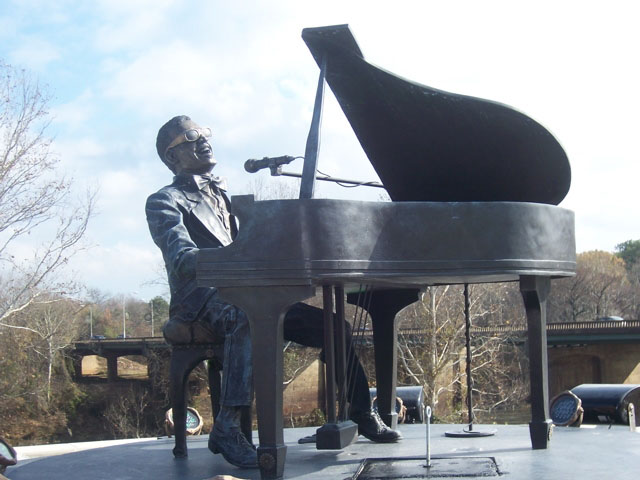
Photograph by Meg Inscoe
A special exhibition of memorabilia and video recordings entitled "The Genius of Ray Charles" opened in November 2004 at the Rock and Curl Hall of Fame in Cleveland, Ohio, and in September 2005 Rhino Records released Pure Genius: The Complete Atlantic Recordings (1952-1959), a CD/DVD boxed set.
The Ray Charles Plaza in Albany, which commemorates the vocalist with a bronze revolving statue, opened in December 2007.
Source: https://www.georgiaencyclopedia.org/articles/arts-culture/ray-charles-1930-2004/
0 Response to "When Did Ray Charles Olay in Georgia Again"
Post a Comment