what is the monetary return to labor called
In economics, diminishing returns is the decrease in marginal (incremental) output of a production process as the amount of a single factor of product is incrementally increased, holding all other factors of production equal (ceteris paribus).[ane] The police of diminishing returns (also known as the police of diminishing marginal productivity) states that in productive processes, increasing a cistron of production by i unit, while holding all other production factors constant, volition at some point render a lower unit of output per incremental unit of input.[2] [3] The police of diminishing returns does not cause a subtract in overall production capabilities, rather it defines a signal on a production curve whereby producing an boosted unit of output volition result in a loss and is known as negative returns. Under diminishing returns, output remains positive, however productivity and efficiency decrease.
The modern understanding of the law adds the dimension of holding other outputs equal, since a given procedure is understood to be able to produce co-products.[4] An example would be a manufacturing plant increasing its saleable product, but as well increasing its CO2 product, for the same input increment.[2] The law of diminishing returns is a fundamental principle of both micro and macro economics and it plays a central part in production theory.[5]
The concept of diminishing returns can be explained by considering other theories such equally the concept of exponential growth.[vi] Information technology is commonly understood that growth will not continue to ascension exponentially, rather information technology is subject to dissimilar forms of constraints such equally limited availability of resources and capitalisation which tin can cause economic stagnation. This instance of production holds true to this common understanding as production is subject area to the four factors of production which are country, labour, capital and enterprise. These factors accept the ability to influence economic growth and can eventually limit or inhibit continuous exponential growth.[7] Therefore, as a result of these constraints the production process will somewhen reach a betoken of maximum yield on the production curve and this is where marginal output will stagnate and move towards zero.[8] However information technology should as well exist considered that innovation in the form of technological advances or managerial progress tin minimise or eliminate diminishing returns to restore productivity and efficiency, and to generate profit.
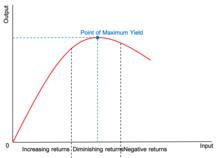
Diminishing Returns Graph The graph highlights the concept of diminishing returns past plotting the curve of output against input. The areas of increasing, diminishing and negative returns are identified at points forth the bend. There is likewise a point of maximum yield which is the point on the curve where producing another unit of output becomes inefficient and unproductive.
This thought can be understood outside of economics theory, for example, population. The population size on Earth is growing rapidly, just this will not proceed forever (exponentially). Constraints such as resources will see the population growth stagnate at some betoken and brainstorm to turn down.[6] Similarly, it will brainstorm to reject towards goose egg, but not actually become a negative value. The same idea as in the diminishing rate of return inevitable to the product procedure.

Effigy 2: Output vs. Input [top] & Output per unit of measurement Input vs. Input [bottom] Seen in [meridian], the modify in output by increasing input from Li to 502 is equal to the change from Lii to 50three. Seen in [bottom], until an input of Lane, the output per unit is increasing. After Lone, the output per unit decreases to zero at L3. Together, these demonstrate diminishing returns from L1.
History [edit]
![[icon]](https://upload.wikimedia.org/wikipedia/commons/thumb/1/1c/Wiki_letter_w_cropped.svg/20px-Wiki_letter_w_cropped.svg.png) | This section needs expansion. Yous tin assistance by adding to it. (December 2009) |
The concept of diminishing returns can be traced back to the concerns of early economists such as Johann Heinrich von Thünen, Jacques Turgot, Adam Smith,[nine] James Steuart, Thomas Robert Malthus, and [10] David Ricardo. Notwithstanding, classical economists such every bit Malthus and Ricardo attributed the successive diminishment of output to the decreasing quality of the inputs whereas Neoclassical economists assume that each "unit" of labor is identical. Diminishing returns are due to the disruption of the entire production process every bit boosted units of labor are added to a fixed corporeality of capital letter. The law of diminishing returns remains an of import consideration in areas of product such as farming and agriculture.
Proposed on the cusp of the First Industrial Revolution, information technology was motivated with single outputs in mind. In recent years, economists since the 1970s take sought to redefine the theory to brand information technology more appropriate and relevant in modernistic economical societies.[4] Specifically, it looks at what assumptions can be made regarding number of inputs, quality, substitution and complementary products, and output co-production, quantity and quality.
The origin of the law of diminishing returns was adult primarily within the agricultural manufacture. In the early 19th century, David Ricardo besides as other English economists previously mentioned, adopted this police as the outcome of the lived experience in England after the state of war. It was developed by observing the relationship between prices of wheat and corn and the quality of the land which yielded the harvests.[eleven] The observation was that at a sure point, that the quality of the land kept increasing, but so did the cost of produce etc. Therefore, each boosted unit of labour on agricultural fields, actually provided a diminishing or marginally decreasing return.
Case [edit]

Figure 2 [One-time]: Total Output vs. Total Input [superlative] & Output per unit Input vs. Full Input [bottom] Seen in TOP, the alter in output by increasing output from 501 to Lii is equal to the change from L2 to Lthree. Seen in Bottom, until an output of Lane, the output per unit of measurement is increasing. Later on Fifty1, the output per unit of measurement decreases to zero at 50iii. Together, these demonstrate diminishing returns from Fifty1.
A common example of diminishing returns is choosing to hire more than people on a factory flooring to modify current manufacturing and production capabilities. Given that the capital on the floor (e.g. manufacturing machines, pre-existing technology, warehouses etc.) is held constant, increasing from one employee to two employees is, theoretically, going to more than double product possibilities and this is called increasing returns.
If we now utilize fifty people, at some indicate increasing the number of employees by 2 percent (from 50 to 51 employees) would increase output past 2 percentage and this is called constant returns.
However, if we wait further along the production curve to for example 100 employees, floor space is probable getting crowded, there are too many people operating the machines and in the building and workers are getting in each other'south style. Increasing the number of employees past ii pct (from 100 to 102 employees) would increase output past less than two percent and this is called "diminishing returns".
Through each of these examples, the floor space and capital of the factor remained abiding i.east. these inputs were held abiding. Even so, past just increasing the number of people somewhen the productivity and efficiency of the process moved from increasing returns to diminishing returns.
To understand this concept thoroughly, admit the importance of marginal output or marginal returns. Returns somewhen diminish because economists measure productivity with regard to additional units (marginal). Additional inputs significantly impact efficiency or returns more than in the initial stages.[12] The point in the procedure before returns begin to diminish is considered the optimal level. Being able to recognise this point is beneficial, as other variables in the production function can be contradistinct, rather than continually increasing labour.
Further, examine something such as the Human Evolution Index, which would presumably proceed to ascension so long as GDP per capita (in Purchasing Ability Parity terms) was increasing. This would be a rational assumption considering Gdp per capita is a function of HDI. All the same, even Gross domestic product per capita will reach a bespeak where it has a diminishing rate of return on HDI.[thirteen] Simply recollect, in a low income family, an average increment of income by $100, volition likely make a huge touch on the wellbeing of the family. Parents could provide abundantly more food and healthcare essentials for their family unit. That is a significantly increasing rate of return. But, if yous gave the aforementioned increment to a wealthy family unit, the impact it would accept on their life, would exist minor. Therefore, the rate of return provided by that $100 boilerplate increase in income, is diminishing.
Mathematics [edit]
Signify

Increasing Returns:

Constant Returns:

Diminishing Returns:

Production Part [edit]
At that place is a widely recognised production function in economics: Q= f(NR, L, K, t, East):
- The point of diminishing returns can exist realised, by use of the second derivative in the to a higher place production office.
- Which tin be simplified to: Q= f(L,K).
- This signifies that output (Q) is dependent on a function of all variable (L) and fixed (K) inputs in the production process. This is the footing to sympathize. What is important to understand after this is the math backside Marginal Product. MP= ΔTP/ ΔL. [xiv]
- This formula is important to relate back to diminishing rates of render. It finds the alter in total product divided by modify in labour.
- The Marginal Product formula suggests that MP should increase in the short run with increased labour. Notwithstanding, in the long run, this increase in workers will either have no effect or a negative effect on the output. This is due to the issue of fixed costs as a function of output, in the long run.[15]
Link with Output Elasticity [edit]
Get-go from the equation for the Marginal Product:

To demonstrate diminishing returns, two conditions are satisfied; marginal production is positive, and marginal product is decreasing.
Elasticity, a function of Input and Output, , can be taken for small-scale input changes. If the to a higher place two atmospheric condition are satisfied, and so 
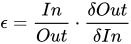
This works intuitively;
- If is positive, since negative inputs and outputs are impossible,
- And is positive, since a positive return for inputs is required for diminishing returns


- And so

- is relative alter in output, is relative change in input
- The relative modify in output is smaller than the relative alter in input; ~input requires increasing try to change output~


- Then

Returns and costs [edit]
There is an inverse relationship betwixt returns of inputs and the cost of production,[17] although other features such every bit input market weather tin also touch production costs. Suppose that a kilogram of seed costs one dollar, and this price does non change. Presume for simplicity that there are no stock-still costs. Ane kilogram of seeds yields one ton of crop, so the first ton of the crop costs ane dollar to produce. That is, for the showtime ton of output, the marginal price as well as the average cost of the output is $i per ton. If there are no other changes, then if the second kilogram of seeds applied to land produces only half the output of the starting time (showing diminishing returns), the marginal cost would equal $i per half ton of output, or $2 per ton, and the average cost is $two per 3/2 tons of output, or $4/iii per ton of output. Similarly, if the third kilogram of seeds yields only a quarter ton, then the marginal price equals $1 per quarter ton or $four per ton, and the average cost is $iii per 7/four tons, or $12/7 per ton of output. Thus, diminishing marginal returns imply increasing marginal costs and increasing average costs.
Cost is measured in terms of opportunity cost. In this case the law also applies to societies – the opportunity toll of producing a unmarried unit of a good generally increases as a society attempts to produce more of that skilful. This explains the bowed-out shape of the production possibilities frontier.
Justification [edit]
Ceteris Paribus [edit]
Part of the reason one input is altered ceteris paribus, is the idea of disposability of inputs.[xviii] With this assumption, essentially that some inputs are higher up the efficient level. Meaning, they can decrease without perceivable impact on output, after the manner of excessive fertiliser on a field.
If input disposability is assumed, and so increasing the principal input, while decreasing those excess inputs, could result in the same 'macerated return', every bit if the principal input was changed certeris paribus. While considered every bit 'hard' inputs, similar labour and assets, diminishing returns would hold true. In the modern accounting era where inputs tin can be traced back to movements of financial capital, the same example may reflect constant, or increasing returns.
Information technology is necessary to be clear of the 'fine construction'[4] of the inputs before proceeding. In this, ceteris paribus is disambiguating.
See also [edit]
- Diminishing marginal utility, also not to be mistaken for 'diminishing returns'
- Diseconomies of scale, does not assume stock-still inputs, and considers costs, thus differing from 'diminishing returns'
- Economies of scale
- Gold plating (project direction)
- Learning bend and Feel curve effects
- Liebig's Law of the minimum
- Marginal value theorem
- Opportunity cost
- Returns to scale
- Pareto efficiency
- Submodular gear up function
- Sunk-cost fallacy
- Tendency of the charge per unit of profit to autumn
- Assay paralysis
- Teamwork
- Amdahl's law
References [edit]
Citations [edit]
- ^ "Diminishing Returns". Encyclopaedia Britannica. Encyclopaedia Britannica. 2017-12-27. Retrieved 2021-04-22 .
- ^ a b Samuelson, Paul A.; Nordhaus, William D. (2001). Microeconomics (17th ed.). McGraw-Loma. p. 110. ISBN0071180664.
- ^ Erickson, One thousand.H. (2014-09-06). Economics: A Simple Introduction. p. 44. ISBN978-1501077173.
- ^ a b c Shephard, Ronald W.; Färe, Rolf (1974-03-01). "The law of diminishing returns". Zeitschrift für Nationalökonomie. 34 (one): 69–90. doi:ten.1007/BF01289147. ISSN 1617-7134. S2CID 154916612.
- ^ Encyclopædia Britannica. Encyclopædia Britannica, Inc. 26 Jan 2013. ISBN9781593392925.
- ^ a b "Exponential growth & logistic growth (article)". Khan University . Retrieved 2021-04-19 .
- ^ "What is Production? | Microeconomics". courses.lumenlearning.com . Retrieved 2021-04-19 .
- ^ Pichère, Pierre (2015-09-02). The Law of Diminishing Returns: Understand the fundamentals of economic productivity. 50Minutes.com. p. 17. ISBN978-2806270092.
- ^ Smith, Adam. The wealth of nations. Thrifty books. ISBN9780786514854.
- ^ Pichère, Pierre (2015-09-02). The Law of Diminishing Returns: Understand the fundamentals of economic productivity. 50Minutes.com. pp. ix–12. ISBN978-2806270092.
- ^ Cannan, Edwin (March 1892). "The Origin of the Police of Diminishing Returns, 1813-15". The Economic Journal. 2 (5): 53–69. doi:10.2307/2955940. JSTOR 2955940.
- ^ "Police force of Diminishing Returns & Point of Diminishing Returns Definition". Corporate Finance Institute . Retrieved 2021-04-26 .
- ^ Cahill, Miles B. (October 2002). "Diminishing returns to Gross domestic product and the Human Evolution Index". Applied Economic science Messages. 9 (xiii): 885–887. doi:10.1080/13504850210158999. ISSN 1350-4851. S2CID 153444558.
- ^ Carter, H. O.; Hartley, H. O. (April 1958). "A Variance Formula for Marginal Productivity Estimates using the Cobb-Douglas Function". Econometrica. 26 (2): 306. doi:10.2307/1907592. JSTOR 1907592.
- ^ "The Production Function | Microeconomics". courses.lumenlearning.com . Retrieved 2021-04-21 .
- ^ Robinson, R. Clark (July 2006). "Math 285-2 - Handouts for Math 285-2 - Marginal Product of Labor and Capital" (PDF). Northwestern - Weinberg Higher of Arts & Sciences -Department of Mathematics . Retrieved 1 November 2020.
- ^ "Why It Matters: Production and Costs | Microeconomics". courses.lumenlearning.com . Retrieved 2021-04-19 .
- ^ Shephard, Ronald W. (1970-03-01). "Proof of the law of diminishing returns". Zeitschrift für Nationalökonomie. 30 (1): 7–34. doi:x.1007/BF01289990. ISSN 1617-7134. S2CID 154887748.
Sources [edit]
- Case, Karl E.; Fair, Ray C. (1999). Principles of Economics (fifth ed.). Prentice-Hall. ISBN0-13-961905-4.
Source: https://en.wikipedia.org/wiki/Diminishing_returns
0 Response to "what is the monetary return to labor called"
Post a Comment