When Will Mt St Helens Reupt Again
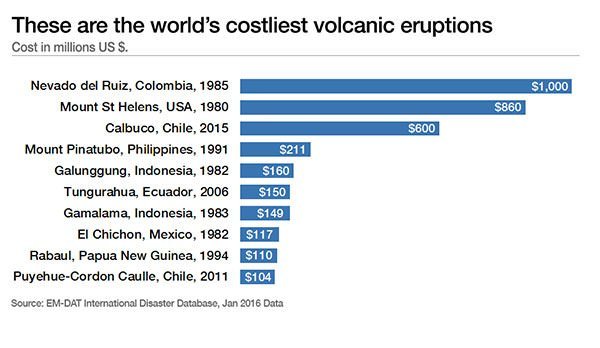
Mount St. Helens is an active volcano in Skamania County in the U.Due south. country of Washington. After more than than a century of inactivity, it reawakened in March 1980. A serial of earthquakes and eruptions followed and on May xviii, the notorious eruption of Mt St. Helens occurred leading to destruction as far every bit 19 kilometers from the volcano. The 1980 eruption of Mt St. Helens caused the expiry of 57 people and was the most deadly and economically destructive eruption in US history with the harm acquired by information technology estimated to exist effectually $1.one billion. It was classified as a VEI-5 upshot and is considered to be equivalent to 1,600 times the size of the atomic bomb dropped on Hiroshima. Know more than nigh the cause, destruction, casualties and furnishings of the 1980 Mt St. Helens eruption through these 10 interesting facts.
#one It was caused due to subduction of Juan de Fuca Plate under the North American Plate
Mount St. Helens is located in the Pour Range, which is a part of Pacific Ocean's Ring of Fire. The Ring of Fire has 452 volcanoes and information technology has been responsible for all but three of world's 25 largest volcanic eruptions in the last eleven,700 years. Volcanic action in the Band of Burn down is a upshot of plate tectonics, or the movement of the plates of the Earth's lithosphere or outermost crush. Subduction is a geological process at convergent boundaries of tectonic plates where i plate moves nether another. Volcanic activity in Mount St. Helens is due to the Juan de Fuca Plate, an oceanic plate, subducting under the North American Plate, a continental plate. The weight of water on oceanic plates increases the density of oceanic chaff to the signal where it begins to slide under the continental plate.

#ii American volcanologists Crandell and Mullineaux predicted the Mt St Helens eruption
Mount St. Helens had remained dormant since its concluding menses of activity in the 1840s and 1850s. Several years before the reawakening of Mt St Helens, the US Geological Survey (USGC) conducted a study of the volcanoes in the Cascade Range equally part of its Volcano Hazards Program. From these studies, USGC scientists concluded that Mt St Helens was the youngest; and most active and explosive of the Cascade volcanoes. In 1975, they made a forecast that Mount St. Helens would erupt once again, "maybe before the cease of the century." In 1978, in a more detailed study, American volcanologists Dwight Crandell and Donal R. Mullineaux, amplified their before conclusions and marked the near chancy areas on a map in example Mount St. Helens erupted.

#three Information technology was preceded by a two-month-long series of earthquakes and small eruptions
On March xvi, 1980, the offset sign of activity occurred at Mount St. Helens as a series of minor earthquakes. On March 20, a magnitude four.ii earthquake signaled the reawakening of the volcano after 123 years. From March 25 to March 27, quakes of magnitude iv.0 rocked the mountain as many as iii times a day, and smaller quakes occurred several times every hr. At 12:36 pm on March 27, Mount St. Helens produced its showtime eruption in over 100 years. This created a new crater which was 250 feet (76 chiliad) broad. Past April eight, the ii craters merged. The combined crater was 1,700 ft by 1,200 ft and 500 ft deep (520×370×150 grand). The March 27 eruption was followed by a series of earthquakes and eruptions till April 22, when the first period of activity ceased. Small eruptions resumed on May 7 and connected till the master event.
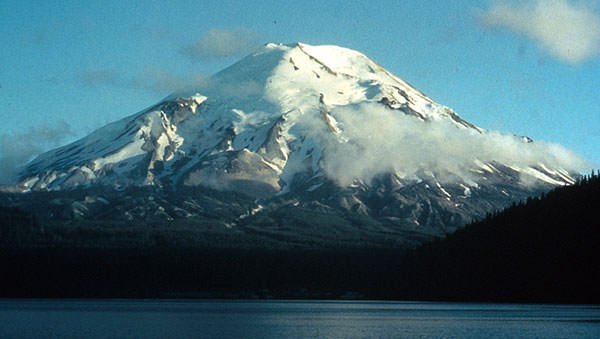
#four Rising magma in the volcano deformed its shape leading to an outward burl
On March 31, instruments recorded rhythmic pulses, known equally "volcanic tremors", which indicated that magma (molten rock) was on the move. The rising magma acquired a deformation in the shape of Mt St Helens pushing its north flank outward at a rate of about 2 grand (6.5 ft) per twenty-four hour period. On Apr 30, geologists announced that sliding of the bulge area was the greatest immediate danger and that such a landslide might spark an eruption. By mid-May, this threatening bulge had grown outward by around 450 feet (140 m). As magma of the volcano remained below the ground and was non direct visible, it was chosen a cryptodome, which is created by accumulation of viscous magma at a shallow depth.
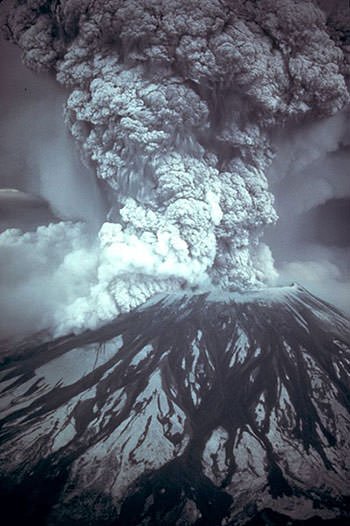
#v Volcanic activity at Mt St Helens resulted in the largest landslide in recorded history
At 8:32 a.k. on May xviii, 1980, a magnitude 5.1 earthquake occurred which was centered straight below the north slope of Mt St Helens. Around 10 seconds afterwards the shock, the volcano's northern burl and summit slid abroad causing the largest terrestrial landslide in recorded history. The total avalanche volume was nigh 2.5 kilometers cube (3.3 billion cubic yards). The landslide removed role of the cryptodome growing inside the volcano. This resulted in firsthand depressurization of the volcano's very hot and highly pressurized body of magma triggering powerful eruptions laterally through the sliding debris. This lateral (sideways) blast blew out pyroclastic flow of very hot gases and volcanic matter with speeds which reached upwardly to 670 mph (1,080 km/h) and might have briefly passed the speed of sound (1234.8 km/h )
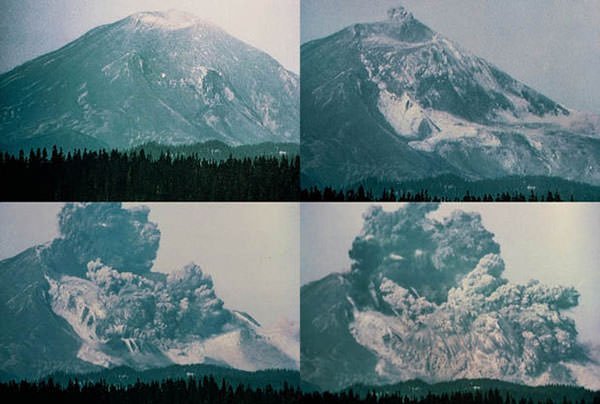
#6 The ash deject of the eruption turned daylight into darkness in eastern Washington
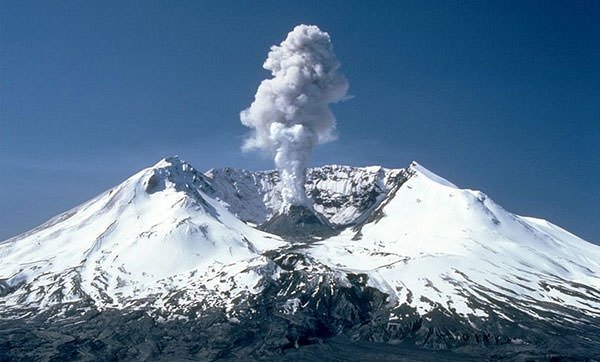
Soon later on the lateral nail, a second, vertical explosion occurred at the summit of the volcano. This send a mushroom cloud of ash and gases more than 12 miles into the air. The dense ash deject turned daylight into darkness in eastern Washington and streetlights had to be turned on in the cities of Yakima and Ritzville. The eruption of ash continued for nine hours. Most the volcano, the swirling ash particles in the atmosphere generated lightning, which in turn started many forest fires. Ultimately, an estimated 540 million tons (490,000 kilotons) of ash drifted upwardly to ii,200 square miles (5,700 square km) settling over seven US states. The volcanic ash deject drifted east beyond the United states in 3 days and encircled the globe in 15 days.
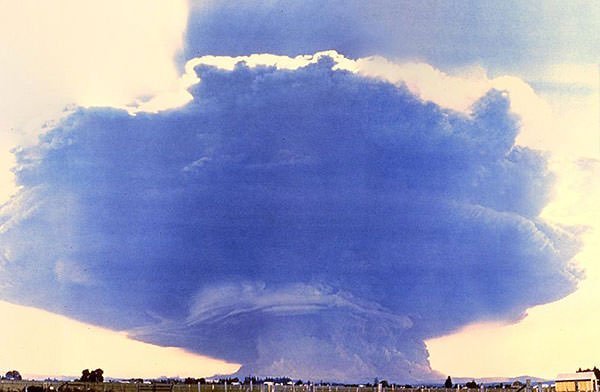
#7 The eruption caused destruction equally far as 19 kilometers from the volcano
The near-supersonic lateral blast of Mt St Helens wiped everything within eight miles and caused destruction equally far as 19 miles (31 km) from the volcano. More than 4 billion lath feet (9,400,000 cubic meters) of timber was damaged or destroyed during the Mt St Helens eruption, mainly by the lateral blast. Many agriculture crops were destroyed; and thousands of birds, mammals, reptiles, amphibians; and millions of hatchery fingerlings perished. As well, as a result of the eruption, snow, water ice and several entire glaciers on the volcano melted forming a series of large lahars (volcanic mudslides). The largest of these lahars occurred in the North Fork Toutle river; increased in size equally information technology traveled downstream; and reached its maximum size in the Cowlitz River, about 80 km (50 mi) downstream from the volcano.
#8 Mt St Helens eruption was the most economically destructive eruption in US history
The May 18, 1980 Mt St Helens eruption was the about deadly and economically destructive volcanic eruption in the history of the The states. 57 people are known to have died straight due to the event while 2 were killed in accidents that resulted from poor visibility and two more suffered fatal center attacks from volcanic ash. Nearly of the directly victims succumbed to asphyxiation while several died from burns. More than 185 miles (298 km) of highway, 15 miles (24 km) of railways, 200 houses and 47 bridges were destroyed due to the eruption. The total cost of the destruction and damage caused by the Mountain Saint Helens eruption was around $1.one billion ($two.89 billion in 2015 dollars).
#nine It was 1600 times more than powerful than the atomic flop dropped on Hiroshima
The Mt St Helens eruption is classified as a VEI-v outcome, i.due east. it ejected more than 1 cubic kilometers of tephra (material produced by a volcanic eruption). The most powerful volcanic eruption in recorded history is the 1815 Eruption of Mount Tambora, a VEI-vii outcome, i.e. it ejected more than 100 cubic kilometers of tephra. The total amount of energy released in Mt St Helens eruption was 24 megatons, 7 of which were a directly result of the blast. This is equivalent to one,600 times the size of the atomic bomb dropped on Hiroshima. The total amount of material ejected by information technology was more than 0.67 cubic miles (two.79 cubic kilometers ). The 1980 eruption reduced the superlative of Mount St. Helens by around i,300 ft from 9,677 ft (2,950 m) to 8,363 ft (2,549 grand); and it left a 1 to 2 miles (2 to three km) wide and two,100 anxiety (640 m) deep horseshoe-shaped crater.
#x Mt St Helens eruption led to the germination of the globe'southward youngest glacier
On August 27, 1982, U.Due south. President Ronald Reagan established the Mount St. Helens National Volcanic Monument. Information technology is an 110,000 acres (45,000 ha) surface area around the mountain for recreation, research and instruction regarding the effect and the subsequent recovery. In 1987, the U.S. Forest Service reopened the mountain to climbing. Nonetheless, four explosions in 2004, that blasted steam and ash upward to x,000 anxiety higher up the crater, acquired the closure of the area again. Subsequently its reawakening in Oct 2004, volcanic activeness connected in Mt St Helens till January 2008, when it finally ceased once again. After the 1980 eruption, snow and stone accumulating in the horseshoe-shaded crater at Mt St. Helens formed Crater Glacier, the youngest glacier on Earth. 2004 to 2008 volcanic eruptions significantly altered its appearance merely an underlying rock layer provided it insulation and ensured its survival.
Source: https://learnodo-newtonic.com/mt-st-helens-eruption-facts
0 Response to "When Will Mt St Helens Reupt Again"
Post a Comment